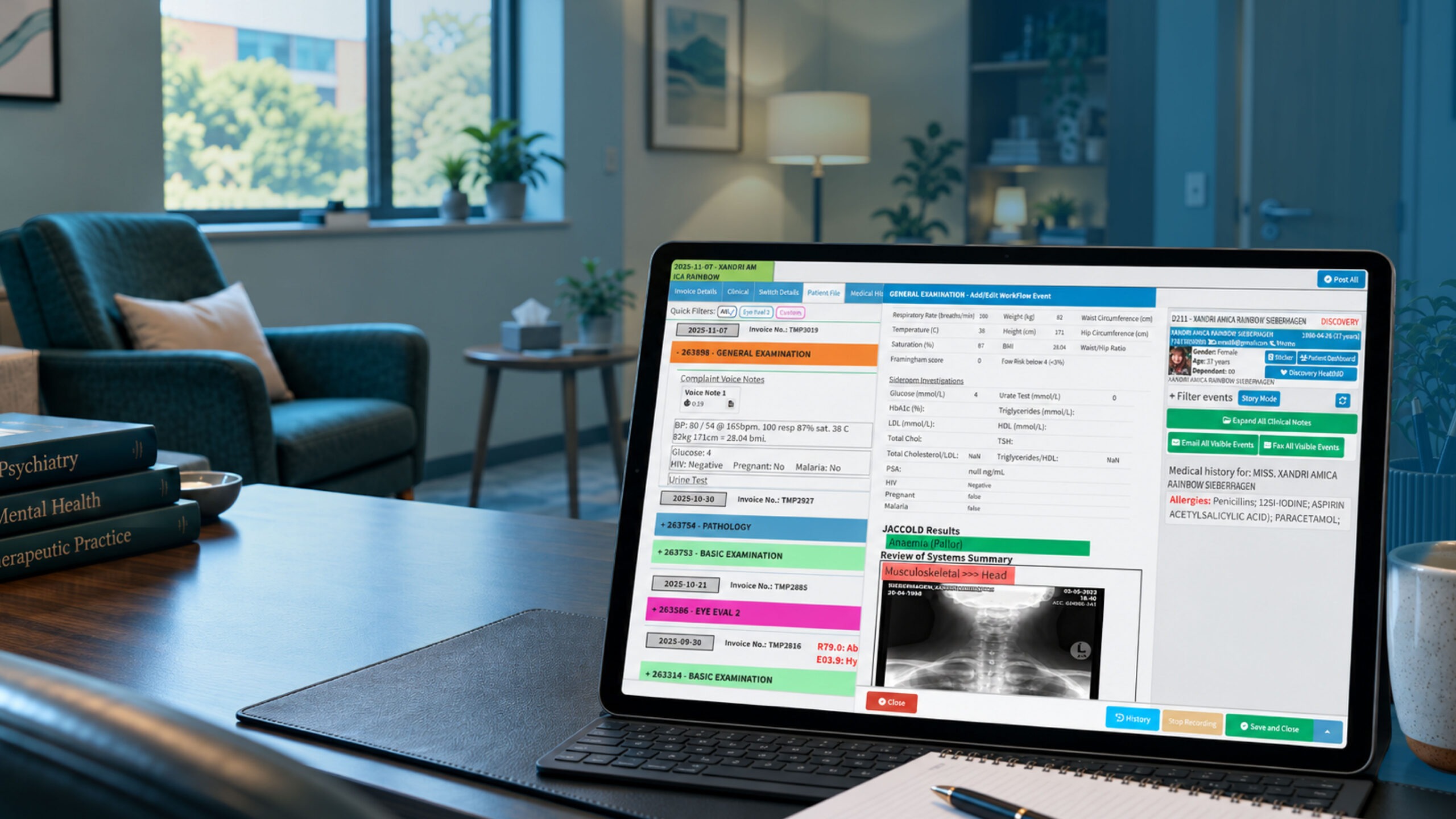
Picture a Monday morning in a Gaborone consulting room. Eleven patients are booked, two are new, and one of the returning patients is on a medication change that needs careful notes. By ten o’clock you’re already behind on your writing. Good psychiatry EHR software should take that pressure down, not add to it.
Psychiatric records are different from the rest of medicine. You’re capturing mood, risk, insight, family dynamics and the reasoning behind a decision, and much of it is sensitive enough that a careless disclosure could wreck someone’s job or marriage. A generic template built for a general practitioner rarely copes.
This article covers what a Botswana psychiatry practice needs to document, how to protect it, and what to look for in electronic medical records for mental health practice. The legal anchor is the Data Protection Act 2018, which came into effect on 15 October 2021, according to the Data Protection Africa fact sheet on Botswana. Registration and conduct questions sit with the Ministry of Health and Wellness and the professional bodies it works with.
A Psychiatric Progress Notes Template That Respects Your Time
A good psychiatric progress notes template is short. That sounds odd, but the National Academy of Medicine has argued that billing-driven notes drifted away from recording the patient’s story, and it recommends limiting notes to what is clinically essential. Psychiatry is especially prone to this drift, because narrative notes grow long and nobody rereads them.
A workable structure has five parts. Keep each one to a few lines unless something has changed.
- Presenting concerns since the last visit, in the patient’s own words where possible
- Mental state examination, with only the abnormal findings expanded
- Risk assessment, including suicidal ideation, harm to others and safeguarding
- Medication changes, side effects and adherence
- Plan, next review date and who was told what
Risk is the part you can’t skip. If a patient denied suicidal thoughts at 09:20 and you wrote nothing, a later review will show an empty field and no reasoning. One sentence recording that you asked, what the patient said and what you decided is worth more than a paragraph of general observations.
Time matters as well. The American Medical Association describes one organisation that freed about 45 minutes a day through shared templates and fewer alerts, and others that saved 6 to 20 minutes daily with faster login and voice recognition. Those are American figures, so treat them as indicators rather than promises. Still, the lesson travels: shared templates and fewer pop-ups give time back.
Ask yourself how many clicks it takes to open a returning patient, see the last note and start writing. If the answer is more than three, your system is working against you. A small saving repeated across twenty consultations a day adds up quickly.
Mental Health Patient Confidentiality Records Under Botswana’s Data Protection Act
Mental health patient confidentiality records deserve a higher standard than the rest of your files. Health information is treated as sensitive personal data under Botswana’s Data Protection Act, and the Information and Data Protection Commission is the regulator. The Act gives people rights to access, correct, delete and object to the processing of their data, which the Tech Hive Advisory summary of the new Act walks through in plain terms.
What does that mean at your front desk? First, access should follow role. Your receptionist needs to see appointments and contact details, but not the content of a psychotherapy note. Second, every access to a record should leave a trace, so that if a patient asks who opened their file you can answer with facts rather than guesses.
Think about the awkward cases. A patient arrives and the person at the desk recognises them as a neighbour. A spouse phones asking whether the appointment went well. An employer’s HR department requests a letter. In each one, your records system and your staff training should make the default answer “no, not without consent”.
Many practices also keep a separate, restricted section for psychotherapy notes, kept apart from the main clinical record that might be shared with a referring doctor or a medical aid scheme. That separation is good practice rather than a legal formula, so agree it with your own indemnity provider. For wider guidance on retention and clarity, the Medical Protection Society’s record keeping tips are a sensible read, though they come from a UK perspective.
Informed consent and patient privacy belong together here. Record what the patient agreed to share, with whom and for what purpose, and note when they withdrew or changed that agreement. A signed form in a drawer is not enough if nobody can find it when a query arrives. Electronic storage lets you attach consent to the patient record itself, where it’s seen at the moment it matters.
Security basics count too: unique logins, no shared passwords, encrypted backups and a clear plan for lost laptops. A breach involving a psychiatric file is an ethical failure before it’s a regulatory one. If a patient’s diagnosis leaks in a small community, the damage is personal and long lasting.
Treatment Plan Documentation for Psychiatrists That Survives a Review
Treatment plan documentation for psychiatrists is where records usually get thin. Notes accumulate visit after visit, but the plan itself, the thing that explains why you’re doing what you’re doing, lives in someone’s head. When a locum covers your leave, or a patient transfers, that gap shows immediately.
A usable plan names the working diagnosis, ideally coded against the WHO’s ICD classification, and states the goals in terms the patient would recognise. “Sleep six hours a night within a month” is better than “improve sleep hygiene”. It lists the medication and therapy components, the monitoring you’ll do (bloods for lithium, weight and metabolic checks for antipsychotics), and the date you’ll review it.
Revisit the plan at set intervals and record that you did. If nothing changed, say so in one line. If the patient disagreed with part of it, record that too, because a plan the patient never accepted is a plan unlikely to be followed.
Diagnosis codes also matter for claims. Medical aid schemes in Botswana expect clear clinical justification for treatment, particularly for admissions and long courses of therapy. When the diagnosis, the plan and the claim all tell the same story, rejections drop and queries get answered faster.
Consider the family angle as well. Many Botswana patients are supported by relatives, and you may be asked to share parts of the plan. Record who the patient has nominated, what they may be told and what stays private. It takes thirty seconds at the time and prevents a difficult conversation later.
Where GoodX Fits Into Your Psychiatry Practice
GoodX is practice management software built for healthcare providers, and it can carry a good share of the load described above. Clinical records, appointments, billing and reporting sit in one place, so a patient’s booking, notes and account don’t live in three separate systems. For a practice choosing practice management software Botswana, that joined-up view matters more than any single feature.
In day-to-day terms, you can expect structured clinical records with templates that your practice adapts to its own style, access controls so that reception sees what reception needs, and billing and claims tools that reduce manual capture. Automated reminders help with the missed-appointment problem, which is a particular headache in psychiatry where a no-show can signal a relapse. [INTERNAL LINK: appointment reminders and bookings -> GoodX bookings and scheduling page]
Reporting is the quiet benefit. When you can see which patients are overdue for a plan review, or which claims are outstanding, you spend less time chasing and more time with patients. [INTERNAL LINK: clinical records and reporting -> GoodX clinical records page]
Compliance support is part of the picture too, with audit trails and role-based access helping you show that you handle data responsibly. No software makes a practice compliant by itself, since policies and staff habits do that, but the right tools make good habits easier to keep. If you’re moving from paper or an older system, ask about data migration and training. [INTERNAL LINK: getting started with GoodX -> GoodX onboarding page]
Frequently Asked Questions
What should psychiatry EHR software include for Botswana practices?
It should include structured progress notes, risk assessment fields, treatment plan tracking, consent records, role-based access and audit trails. It should also support billing and claims for local medical aid schemes. Ask whether templates can be customised, because every psychiatrist writes differently and rigid forms slow you down.
Does Botswana’s Data Protection Act apply to psychiatric records?
Yes. The Data Protection Act 2018, in force since 15 October 2021, covers personal data, and health information is treated as sensitive. Patients have rights to access, correct, delete and object to processing. The Information and Data Protection Commission oversees compliance.
How long should psychiatric records be kept?
Retention periods depend on your regulator, your indemnity provider and the patient’s age, so confirm the current requirement before setting a rule. Many practitioners keep adult records for several years after the last contact and child records for longer. Check with your professional body and indemnity cover.
Should psychotherapy notes be stored separately?
Many psychiatrists keep them in a restricted section, apart from the general clinical record. This limits what is shared with referrers or funders. It’s a sound practice rather than a fixed legal rule, so agree your approach with your indemnity provider and apply it consistently.
Can electronic records reduce the documentation burden?
Yes, if they’re well designed. Shared templates, fewer alerts, quick login and sensible screen layouts all save time, as examples from other countries show. The gain depends on setup, so involve the clinicians who’ll use the system daily.
Book your free GoodX demo
See how GoodX can support your psychiatry practice with secure records, simpler billing and less admin. Book your free demo at goodx.co.bw and bring your toughest documentation questions with you.
Disclaimer: This article is provided for general informational and educational purposes only. While GoodX Software takes reasonable care to ensure that the information is accurate and current at the time of publication, laws, regulations, industry standards, healthcare policies and technology may change. The content should not be regarded as medical, legal, financial or other professional advice. Readers should verify information relevant to their circumstances and consult an appropriately qualified professional where necessary. GoodX Software accepts no responsibility for decisions made or actions taken solely on the basis of this content.